


The Phone Has Already Won
C-level executives are tapping their smartphones to pay for coffee, board flights, and access their bank accounts. Naturally, they expect the exact same frictionless experience when they walk up to the office door.
Let’s be clear: mobile credentials are no longer a futuristic feature on a product roadmap. They are the locomotive pulling the entire physical access control industry forward. Today, "future-ready" simply means "mobile-ready." The desire to move identities into Apple Wallet or Google Wallet is a major why behind almost every Access control solution (PAC)/Physical Access migration happening right now.
HID deserves real credit for that. HID Mobile Access and the Seos credential technology behind it turned mobile access from a pilot project into something enterprises deploy at scale. For an organization with an established HID environment, extending it to mobile is a proven path, with a credential, a reader and a support model designed to work together. It is one strong answer. It is not the only one.
That is why the next question matters. Knowing where you want to go is the easy part. Getting there across security systems built and expanded over many years is where decisions get hard. Even a reader replacement can require coordination among the building owner, integrator and security team. That caution is justified. It reflects the real consequences of a decision intended to last for years.
The Paralysis of the "Perfect Spec"
The promise of the “perfect spec” is tempting: choose the right technology once and build around it for years. The MIFARE Classic card was once that perfect spec; today, it is a technology with known security weaknesses that organizations should reassess against current requirements. Now, as companies rush toward mobile credentials, they are being forced into high-stakes interrogations: MIFARE Classic vs. MIFARE DESFire? Wiegand vs. OSDP? Bluetooth® Low Energy (BLE) or Near Field Communication (NFC)? HID Seos or open standards like Aliro and PKOC?
Access-control investments often outlast the requirements they were designed to meet. A ten-year reader decision shouldn’t require a crystal ball—but it should leave room for the credentials, standards and security demands of tomorrow.
A choice can be exactly right for today and still need to evolve tomorrow. The real risk is architecture that turns the next requirement into a replacement project instead of an implementation task. This chase for the perfect spec isn't a strategy; it's a trap. Flexibility isn't a hedge against a bad decision; it's what makes a good decision keep paying off as the security landscape changes.
From Hardware Gamble to Insurance Policy
Physical access control is no longer a hardware decision — it is an architectural strategy. You don't buy fire insurance hoping your building burns down; you buy it to protect against catastrophic, unforeseen events. You pay for the certainty that you are covered, no matter what happens.
Similarly, the modern RFID reader is not just a piece of plastic on the wall, but a long-lived integration point in the access-control system. It must be an insurance policy against technological uncertainty. The value of a truly advanced reader isn’t the one protocol or card technology you use today; it's the 99 others you might need over the next decade. It buys you the freedom to be wrong about the future.
Architectural flexibility isn’t about avoiding commitment. HID mobile credentials may be exactly the right choice for an organization, and designing for open standards such as Aliro and PKOC can be part of that same strategy. The point is to build on a sound decision as requirements change—not start over each time they do.
“This is not an argument against any single ecosystem. Choosing HID mobile can be exactly the right call. Choosing an open-standards path can be just as right for another organization. The point is that whichever call you make should stay right when requirements change.”
The Three Pillars of an Insured Decision
This "insurance policy" isn't an abstract concept. It is built on three non-negotiable principles of resilience that allow organizations to migrate to mobile credentials safely:
- Universal Compatibility To survive the transition to mobile without breaking business, an access control platform must be fluent in every credential language. It needs to bridge the gap between the 125kHz cards, including HID prox, still working in the parking garage and the next generation of mobile IDs, whichever wallet or credential approach your organization chooses. This guarantees that no matter what legacy Radio Frequency Identification (RFID) card your workforce carries today, the hardware at the door is ready.
- Architectural Agnosticism The hardware must act as a platform whose capabilities are defined in software. It must be configurable and updateable. When a new security vulnerability is discovered or a new mobile wallet feature is required, the reader can be updated accordingly. This turns a static object on the wall into an evolving endpoint.
- Secure, documented interoperability A reader’s primary job is to deliver secure data to higher-order systems. It must be fluent in all communication protocols, from 40-year-old, unencrypted Wiegand to modern, secure standards like OSDP Secure Channel.
Managing Chaos at the Edge
Migrations rarely fail overnight in a spectacular crash. Instead, they bleed budgets over time through daily operational exceptions, exhaustive test matrices, and forced backend adaptations.
This is where an architecturally agnostic strategy changes the game. Instead of forcing your backend systems to adapt to every new mobile credential or protocol, a smart architecture absorbs this complexity directly at the "edge“ -at the reader on the wall.
By mastering interoperability, a secure platform allows old plastic cards and new mobile credentials to coexist in parallel. That coexistence gives security teams time to retire weaker legacy credentials deliberately, rather than forcing a disruptive overnight “rip-and-replace” rollout. You can phase your adoption at your own pace, keeping the backend stable while upgrading the frontend.
Total Cost of Ownership: Where the Real Costs Hide
The paralysis ends when we realize that no specification removes future uncertainty. The more useful question is how much flexibility architecture preserves. The old questions “Which spec is right?" and "Which technology will win?" have no safe answers. The most powerful question left to ask is: How do I acquire the most options for tomorrow?
Ultimately, the economic viability of migration is not measured by the unit price of a reader, but by Total Cost of Ownership (TCO). A platform approach reduces costs across three critical phases:
- Engineering & Validation: By utilizing a single core reader intelligence across all deployments, organizations drastically reduce SKU fragmentation and integration surprises.
- Deployment & Rollout: Flexible interfaces support phased migrations without requiring repeated hardware swaps or massive backend overhauls.
- Operations: Consistent behavior across the platform reduces daily exceptions, training overhead, and IT support tickets.
The Physical Manifestation of a Secure Strategy
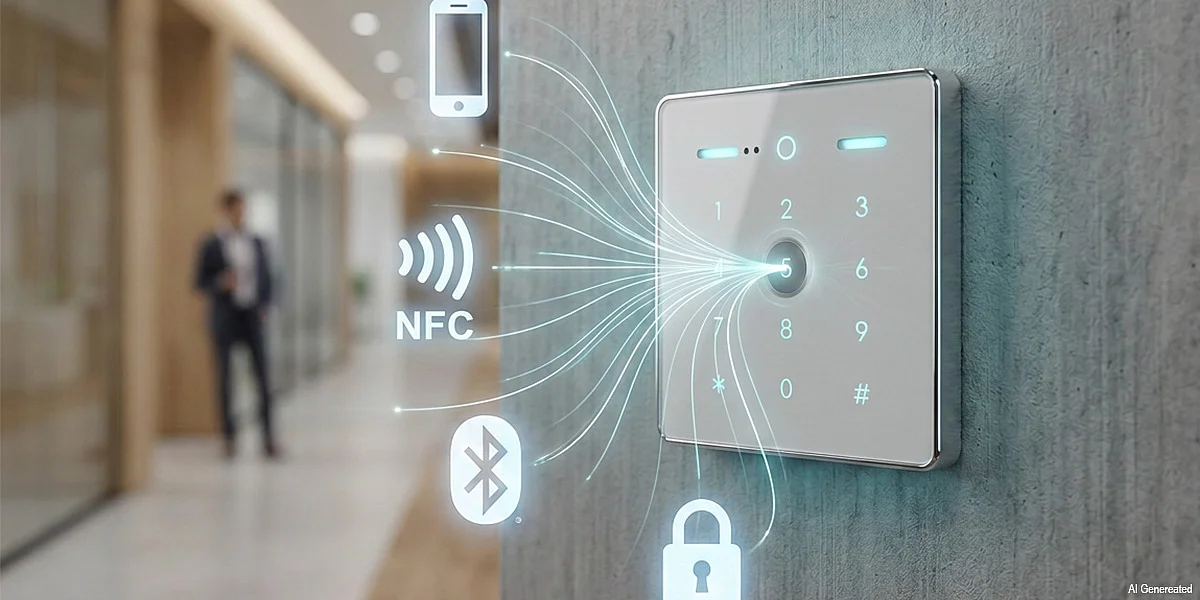
The principles of universal compatibility, architectural agnosticism, and secure, documented interoperability require a robust physical execution. ELATEC’s Secustos Reader Family puts that strategy on the wall. Combining RFID, NFC and BLE with support for more than 100+ physical and mobile credentials and both OSDP and Wiegand interfaces, it gives security teams options as they move from established cards toward mobile credentials. Its slim glass-and-metal design brings that flexibility into modern building architecture.
By investing in an adaptable, architecturally agnostic platform at the edge, you reduce your dependence on predictions about any one technology. Instead, you make a strategic risk-management decision that frees your organization to confidently embrace the mobile revolution today, and whatever comes next tomorrow.
About Bogdan Slobodian
This blog article has been created in collaboration with our Expert Bogdan Slobodian. Bogdan is a Senior Product Manager at ELATEC with experience across engineering, R&D, product development and international communications. Working on ELATEC’s Secustos product family, he bridges business and engineering, translating complexity into clarity and turning ideas into user-focused solutions.

